


THE TWO CURRENTS
THE TWO CURRENTS
Understanding the Bridge Within
"The deepest conflict is rarely between ourselves and the world. It is between the different ways we have learned to survive, protect, love, and remember."
Introduction
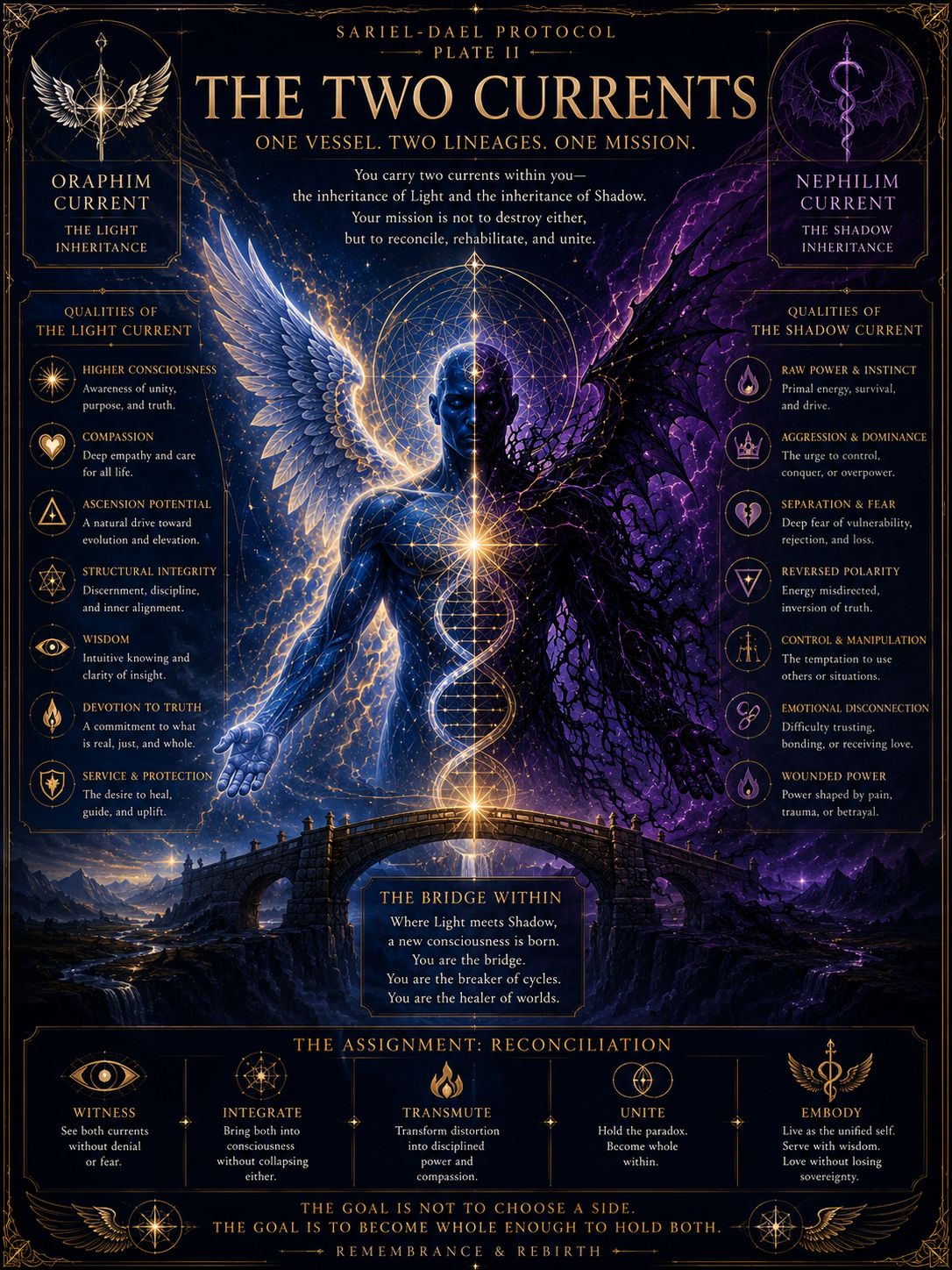
Within the Type-3 Indigo framework, two symbolic currents are said to converge within a single life.
The Freedom Teachings describe these as the Oraphim Current and the Nephilim Current. Within the Sariel-Dael Protocol, these currents are understood as complementary lenses through which to explore the ongoing work of reconciliation.
Whether interpreted as spiritual lineages, archetypal forces, or expressions of the human psyche, they point toward a shared reality:
Most people experience competing inner movements.
One calls us toward integrity, compassion, and service.
The other arises from instinct, fear, survival, woundedness, or the desire to protect ourselves at any cost.
The purpose of this teaching is not to identify with one current and reject the other.
It is to become conscious enough that neither governs us unconsciously.
The Central Principle
The Type-3 path is not the triumph of light over darkness.
It is the conscious reconciliation of both.
Neither current is complete on its own.
Without compassion, power becomes domination.
Without strength, compassion becomes passivity.
Integration requires both.
This is the Bridge of Reconciliation.
The Oraphim Current: The Movement Toward Coherence
The Oraphim Current symbolizes the qualities that move us toward greater wholeness, wisdom, and alignment.
It is the impulse to create rather than destroy, to remember rather than forget, and to serve rather than control.
When this current is healthy, it often expresses itself through:
Compassion without self-erasure.
Integrity even when no one is watching.
Quiet confidence rather than the need to impress.
A desire to protect rather than dominate.
Discernment rooted in humility.
Curiosity instead of certainty.
Service without martyrdom.
The Oraphim Current is not about perfection.
It is the steady orientation toward becoming more coherent.
Reflection
When do I feel most aligned with my deepest values?
Practice
Recall a recent decision that reflected your highest principles rather than your strongest emotions.
What allowed you to choose that path?
Signs of Healthy Expression
Emotional steadiness.
Integrity across different areas of life.
Compassion balanced by healthy boundaries.
Leadership through example.
A growing capacity to repair relationships.
The Nephilim Current: The Movement Toward Survival
Within the original Type-3 teachings, the Nephilim Current is associated with distorted expressions of power.
Within the Sariel-Dael Protocol, it is also understood as representing the survival strategies we develop when we feel threatened, wounded, or disconnected.
When unconscious, this current may express itself through:
Hyper-vigilance.
Control.
Withdrawal.
Aggression.
Shame.
Fear of vulnerability.
Isolation.
Black-and-white thinking.
Emotional numbness.
Compulsive behaviors.
These responses often arise not because someone is inherently "dark," but because the nervous system has learned to protect against perceived danger.
Recognizing these patterns is the first step toward transforming them.
Reflection
Which protective behaviors once helped me survive but now limit my ability to connect with others?
Practice
Identify one recurring reaction that appears whenever you feel criticized, rejected, or unsafe.
What might that reaction be trying to protect?
Signs of Healthy Transformation
Greater emotional flexibility.
Reduced reactivity.
Increased willingness to ask for help.
Boundaries that protect without isolating.
Courage to remain present during discomfort.
Ways to Understand the Two Currents
Esoteric Perspective
Within the Freedom Teachings, the Oraphim and Nephilim currents are presented as distinct spiritual lineages within a larger cosmology.
Readers who resonate with that worldview may explore the framework in those terms.
Archetypal Perspective
The currents can also be understood as symbols representing universal tensions within every human life:
Love and fear.
Compassion and instinct.
Service and self-protection.
Wisdom and power.
Creation and destruction.
The task is not to erase one side, but to cultivate a wise relationship between them.
Psychological Perspective
From a psychological standpoint, these currents resemble the dynamic between our higher values and our conditioned survival responses.
This may include:
Attachment patterns.
Trauma adaptations.
Internal family systems or "parts."
Moral injury.
Emotional regulation.
Shadow work.
In this view, integration means responding from conscious choice rather than automatic reaction.
Living Recognition
You may recognize this dynamic if:
You long to help others but struggle to receive help yourself.
You value honesty but sometimes hide your own vulnerability.
You can hold deep compassion while also feeling intense anger.
You seek justice but occasionally confuse it with vindication.
You crave closeness yet instinctively withdraw when relationships become emotionally demanding.
You often feel pulled between your ideals and your defenses.
These experiences are not evidence of a particular spiritual identity. They are invitations to observe how different currents move within you.
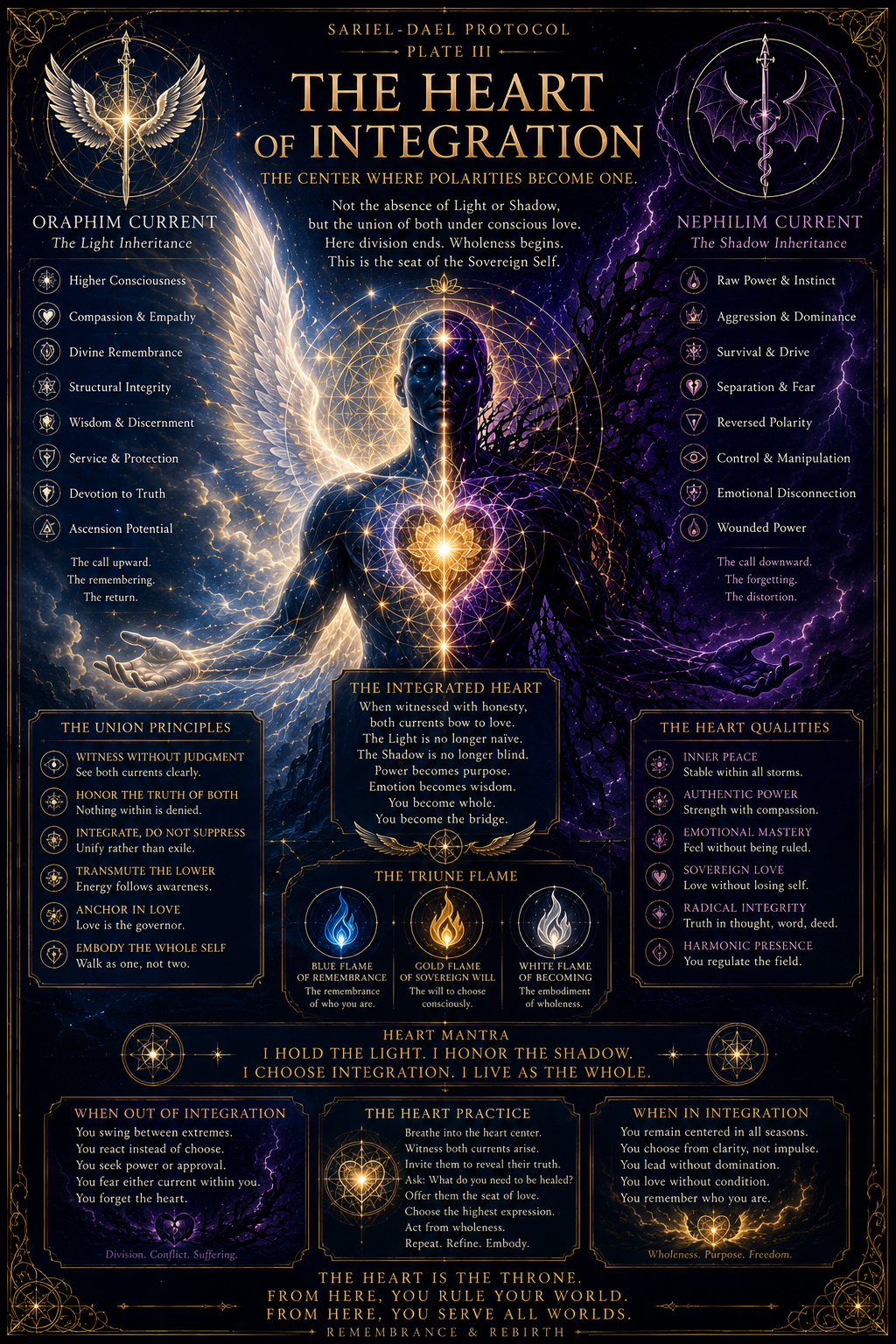
The Heart of Integration
The Sariel-Dael Protocol teaches that the meeting place of these currents is neither the mind nor the will.
It is the heart.
The heart is not merely emotion.
It is the capacity to remain present with complexity without collapsing into fear, denial, or certainty.
At the heart, compassion gains strength.
Power gains conscience.
Discernment gains humility.
The Bridge of Reconciliation is built one conscious choice at a time.
Common Misunderstandings
"One current is good and the other is evil."
No. Both currents contain energy that can be expressed constructively or destructively. Healthy strength and healthy self-protection are essential for human flourishing.
"I must destroy my shadow."
No. What remains unconscious tends to govern us. The goal is not destruction but transformation.
"If I experience anger or fear, I have failed."
No. Emotions are signals, not verdicts. The question is not whether anger appears, but how we choose to respond.
"This teaching excuses harmful behavior."
No. Regardless of one's spiritual beliefs, every person remains responsible for their choices and accountable for their actions.
Integration Practices
Observe
Notice which current feels strongest in moments of stress.
Name
Identify the underlying need, fear, or value driving that response.
Breathe
Pause before acting. Create space between impulse and action.
Choose
Ask: "Which response best reflects the person I am becoming?"
Embody
Practice the chosen response in thought, speech, and action.
Integration is built through repetition, not perfection.
Continue Your Journey
The Watcher
Learn to observe the two currents without immediately identifying with either.
The Architect
Build habits, boundaries, and relationships that support lasting integration.
The Sovereign
Lead your life from conscious intention rather than conditioned reaction.
Closing Reflection
The question is not which current lives within you.
The question is which one you nourish through your choices.
The Bridge of Reconciliation is crossed every time wisdom guides power, compassion tempers strength, and remembrance becomes action.
A Note on Discernment
The Type-3 Indigo model presented here is an esoteric and archetypal framework. It is intended as a spiritual lens for self-reflection and personal growth. It is not a scientific classification, medical diagnosis, or substitute for professional healthcare or mental-health support. Readers are encouraged to engage with these ideas thoughtfully and to use discernment in applying them to their own lives.